
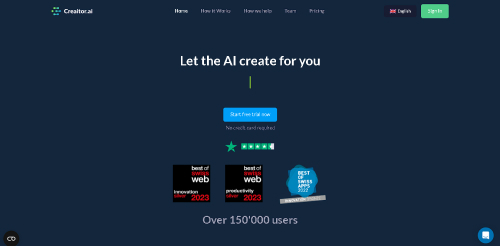
Creaitor AI began as an AI writing assistant, but its current homepage emphasizes a broader problem: measuring how a brand appears across AI search experiences. The platform now positions itself around generative engine optimization (GEO), visibility, position, sentiment, SEO analysis, and content creation. This Creaitor AI review explains the change and how the tools can fit one evidence-led workflow.
Explore Creaitor through the AI Tools Arena referral link. This is an affiliate link, so we may earn a commission at no extra cost to you.
What Is Creaitor AI Today?
Creaitor’s current public product focuses on tracking brand visibility across AI platforms with repeated data points rather than relying on a single generated response. It highlights metrics including visibility, position, and sentiment. Its business and resource pages also retain AI content tools, SEO optimization, keyword and SERP analysis, brand identity controls, multiple assistants, and multilingual output.
That combination can connect measurement and execution: find where a brand is absent or inaccurately represented, improve the relevant source content, and measure again. It should not be mistaken for a guarantee that an AI answer or search ranking will change.
SEO and GEO Are Related, Not Identical
| Area | Primary question | Useful evidence |
|---|---|---|
| Traditional SEO | Can a page rank for a query? | Impressions, clicks, positions, crawl and index data |
| GEO visibility | Is the brand represented in generated answers? | Mentions, position, sentiment, citations, and repeated prompt tests |
| Content quality | Does the page provide a trustworthy answer? | Accuracy, originality, structure, sources, and user behavior |
| Brand consistency | Do channels describe the entity the same way? | Names, categories, claims, profiles, and authoritative references |
A strong program uses both. Search Console data remains important for Google Search performance, while repeated generative-engine observations can expose different visibility gaps.
How to Use Creaitor for SEO and GEO
1. Define the brand entities
List the official organization name, products, people, category, location, and common name variations. Record approved descriptions and facts. Inconsistent entities across pages and profiles make both search engines and AI systems harder to interpret.
2. Build a query set
Group prompts and keywords by intent: brand, category, problem, comparison, tutorial, and purchase decision. Include the phrases real customers use. A small, stable query set is more useful for trend measurement than changing every prompt during each run.
3. Establish a repeated baseline
Use Creaitor’s visibility tracking rather than judging the brand from one AI answer. Record whether the brand appears, its relative position, sentiment, cited sources, and inaccurate descriptions. Generated outputs can vary, which is why repeated observations matter.
4. Compare with search performance
Review the same topic groups in Google Search Console or another first-party analytics source. A page may rank in search but be absent from generated answers, or appear in AI results while receiving little organic traffic. Those patterns call for different actions.
5. Identify a source-content gap
Choose one problem that can be addressed on an authoritative page: an unclear product category, missing comparison, outdated feature description, weak supporting evidence, or unanswered question. Avoid creating several thin pages that compete for the same intent.
6. Use the content tools for a controlled draft
Creaitor’s writing and SEO tools can assist with outlines, meta ideas, brand-aligned drafts, keyword analysis, and content scoring. Supply verified source material and a clear audience. Generate section by section, then add firsthand examples, screenshots, data, and limitations.
7. Strengthen machine-readable clarity
Use descriptive titles and headings, consistent product names, concise definitions, comparison tables where appropriate, and direct answers to common questions. Link to official supporting material. Structured data can help clarify page type and entities when it accurately matches visible content.
8. Publish, measure, and annotate
Record the page update date and what changed. Recheck organic metrics and the same GEO query set over a meaningful interval. Do not claim causation from one observation; algorithm changes, competitors, demand, and source coverage can all affect visibility.
Where Creaitor Is Most Useful
Creaitor can suit marketers and agencies that want content production connected to SEO and AI-search monitoring. A team that only needs occasional copy may not use the measurement layer. A large organization should also evaluate access control, data handling, export options, reporting, and how the platform fits its existing analytics stack.
Creaitor AI FAQ
Is Creaitor still an AI writer?
Yes, official business and resource pages continue to describe writing, SEO, brand, and multilingual content capabilities. However, the current homepage leads with AI-search and GEO visibility measurement.
What does GEO mean?
Generative engine optimization is the practice of improving how accurately and visibly an entity or source appears in AI-generated discovery experiences. It complements rather than replaces traditional SEO.
Can Creaitor guarantee AI citations or rankings?
No. Measurement and optimization tools can guide decisions, but external engines control their results. Use repeated data, authoritative content, and first-party performance metrics.
Final Verdict
Creaitor is now better understood as an SEO-and-GEO platform with content capabilities, not only a generic AI writer. Its strongest workflow begins with repeated visibility measurement, connects findings to real search data, updates one authoritative page, and measures the same query set again.