
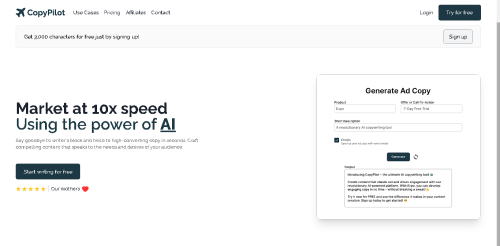
Current status: CopyPilot AI’s legacy affiliate URL currently redirects away from CopyPilot to an unrelated survey domain. The service should therefore be treated as unavailable unless a verified official product site returns. Older social profiles and directories are not sufficient evidence for current features, pricing, support, security, or ownership.
The original affiliate URL is preserved exactly as non-clickable historical text: https://www.copypilot.io/?signupAffiliateUID=LOvwtVTXX2VGq0FG7MiWPP08dkr1. Do not use it for signup: the destination no longer presents a verified CopyPilot product and currently redirects to an unrelated survey domain. Never enter an email, password, client brief, or card number through that legacy route.
What CopyPilot Was Marketed to Do
Historical material positioned CopyPilot as an AI marketing copywriting platform that could help advertisers produce persuasive content. Third-party pages mention templates and copy for ads, social media, and articles. These claims describe the former positioning but should not be presented as a current feature list.
There is also more than one unrelated product online using similar “CopyPilot” or “Copilot” naming. A name match does not prove continuity. Do not redirect users to a different product without verified ownership and a clear reason.
Why Current Verification Matters
| Check | What it protects | Warning sign |
|---|---|---|
| Official ownership | Identity and accountability | No current company or legal entity information |
| Terms and privacy | Content and personal data | Missing, outdated, or unrelated policies |
| Support | Billing and account recovery | No domain-based contact or help channel |
| Secure checkout | Payment information | Unexpected processor, domain, or product name |
| Export and deletion | Business continuity | No way to download or remove content |
A landing page loading successfully is not enough. The complete trust chain must be current and consistent.
What Former CopyPilot Users Should Do
1. Save existing outputs
Export or copy important briefs, templates, brand instructions, and generated drafts while access is available. Store master versions in a document system you control. Do not rely on an unverified AI platform as the only archive for client work.
2. Check recurring charges
Review receipts and payment statements for the exact merchant descriptor. If a subscription continues but support is unavailable, use the contact details in the original receipt or ask the payment provider about cancellation and dispute options.
3. Protect credentials and client data
Change any password reused elsewhere. Avoid uploading confidential strategy, unpublished campaigns, customer lists, or personal data until the service’s current privacy and ownership information has been verified.
4. Document the former workflow
List the templates you used, required inputs, approval steps, output formats, and integrations. This turns replacement selection into a measurable migration instead of a search for an identical interface.
How to Choose a CopyPilot Alternative
Start with the required content types
Separate short conversion copy from long-form editorial work. Ads, landing pages, email sequences, product descriptions, and blog articles require different controls. A tool with many templates is not automatically better if its main workflow does not match your work.
Test with one verified brief
Create a brief containing the audience, product facts, differentiator, offer, proof, prohibited claims, tone, and CTA. Run the same brief through shortlisted tools. Compare accuracy, editing time, brand fit, variation quality, and the ability to preserve exact links.
Inspect governance features
For team or client use, look for workspaces, roles, brand rules, approval states, version history, and exports. Review data retention, model-training settings, deletion controls, and security documentation before uploading proprietary material.
Evaluate total workflow cost
Do not compare subscription prices alone. Include time spent correcting hallucinations, moving copy between tools, managing approvals, and recovering from limits. Confirm current prices directly because AI software plans change frequently.
A Safer AI Copy Workflow
- Research the audience and collect authoritative product facts.
- Write one clear brief with approved and prohibited claims.
- Generate several angles, not a finished campaign in one click.
- Select ideas a human can support with evidence.
- Draft channel-specific copy and preserve official URLs.
- Run legal, factual, brand, and platform-policy checks.
- Approve manually and archive the final version outside the AI tool.
- Measure performance and feed real results into the next brief.
This process remains useful even when the software changes because the durable asset is the brief and approval system, not a particular template library.
CopyPilot AI FAQ
Is CopyPilot AI still active?
Its current operation could not be confirmed from a verified official product presence during this update. Treat old reviews and pricing as historical until an authoritative source is available.
Is the old affiliate link safe to use?
It is retained for transparency, not endorsed as a current signup route. Verify the destination’s ownership, policies, support, and checkout before sharing information.
Can I redirect this page to another AI writer?
Not safely without evidence that the other URL is the official successor and without search and backlink analysis. A transparent status page avoids misleading users and preserves the existing URL.
What is the best replacement?
The best replacement depends on content types, team controls, data policy, source handling, exports, and editing time. Test candidates with the same brief instead of relying on feature counts.
Final Verdict
CopyPilot should be treated as an unverified legacy listing until a current official source establishes otherwise. Preserve important work, check billing, secure reused credentials, and migrate to a tool with clear ownership and data controls. Keeping this article updated is safer than deleting it or sending readers to an unrelated alternative.